Vertex in Astrology: The Hidden Point in Your Birth Chart That Reveals Fated Encounters and Soulmate Connections

Most people read their Sun, Moon, and Rising and stop right there. But buried inside every birth chart is a quieter point that almost no one talks about until they meet the person who unlocks it. Astrologers call this point the Vertex, and it has a strange reputation: things that touch it tend to feel less like ordinary life and more like destiny tapping you on the shoulder.
If you have ever met someone and instantly felt, "I know you from somewhere I cannot name," there is a good chance their planets were sitting on your Vertex. This article breaks down what the Vertex actually is, how to find yours, what it means in each sign and house, and how to read it when two charts meet.
What Is the Vertex in Astrology?
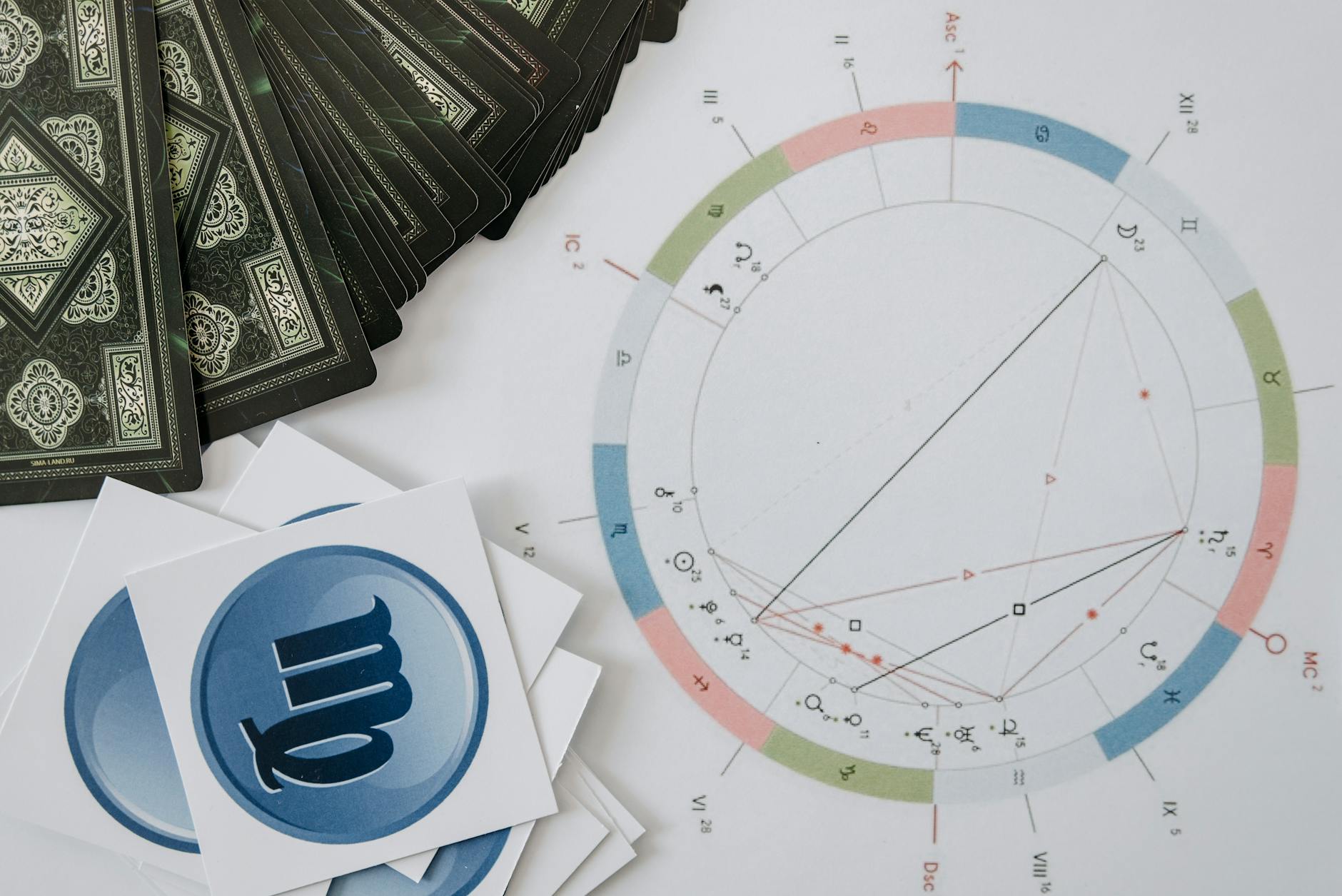
The Vertex is not a planet or an asteroid. It is a mathematical point — specifically, the place where the ecliptic (the path of the Sun) crosses the prime vertical (a great circle running east to west through your exact birth location) on the western side of the chart. It almost always lands somewhere between the 5th and 8th houses of a natal chart.
Because it is calculated from your exact birth time and place, the Vertex is one of the most personal points you have. Move your birth time by twenty minutes and the Vertex can shift signs entirely. That sensitivity is part of why it carries so much weight in modern astrology: it is yours and only yours.
Traditional astrology mostly ignored the Vertex. It came into focus in the late 1900s through the work of astrologers like L. Edward Johndro and Charles Jayne, who noticed something odd in their case studies. The Vertex kept showing up at the exact degrees where clients had met the people who changed their lives — partners, mentors, business co-founders, even strangers whose passing comments rewrote their whole direction.
How to Find Your Vertex
You will not see the Vertex on a default chart at most free websites. To find yours, generate a natal chart on Astro.com, Astrodienst, or any chart calculator that lets you add extra points, then enable "Vertex" in the additional objects menu. You need an accurate birth time — within five minutes if possible — for the placement to be trustworthy.
What you are looking for is two pieces of information: the zodiac sign your Vertex sits in, and the house it falls into. The sign tells you the flavor of your fated encounters. The house tells you the area of life where destiny most often shows up at your door.
The Anti-Vertex: The Mirror Side of Destiny
Directly opposite the Vertex sits a second point called the Anti-Vertex. If your Vertex is at 12 degrees Leo, your Anti-Vertex is at 12 degrees Aquarius. Many astrologers describe the Vertex as the place where fate comes to you — often through other people — and the Anti-Vertex as the place where you step toward it through your own choices.
You can think of the axis as a karmic two-way street. The Vertex is the encounter. The Anti-Vertex is what you do with it.
Vertex in the Signs
Vertex in Aries: Fated encounters arrive fast and unmistakable, often through strangers who challenge you to be braver than you thought you could be.
Vertex in Taurus: Destiny shows up in slower, sensory moments — a meal, a quiet evening, an unexpected gift. The right people make your nervous system finally exhale.
Vertex in Gemini: Fate often arrives in conversation. A stranger sits next to you, says one sentence, and rearranges your life. Pay attention to people who change how you think.
Vertex in Cancer: Soulmates feel like home before they feel like romance. Family, chosen or biological, plays a central role in your fated meetings.
Vertex in Leo: Destiny tends to find you on stages — literal or metaphorical. The people meant to change you often see your light before you do.
Vertex in Virgo: Fate hides inside daily routines. The coworker, the regular at your coffee shop, the person who fixes something for you — these "small" people often turn out to be the most important.
Vertex in Libra: The classic placement for fated partnership. One-on-one meetings carry an unusual sense of recognition, like two halves of a sentence finally completing each other.
Vertex in Scorpio: Soulmate encounters are intense, transformative, and often connected to themes of intimacy, loss, or rebirth. There is nothing casual about your fated people.
Vertex in Sagittarius: Fate finds you while you are moving — travel, study, philosophy. Foreign places and big questions tend to deliver your most important meetings.
Vertex in Capricorn: Mentors and authority figures shape your destiny. The right boss, teacher, or older friend can shift the entire arc of your career and life direction.
Vertex in Aquarius: Your soul tribe comes through unexpected groups, online communities, and movements bigger than yourself. Fated friendships matter as much as romance here.
Vertex in Pisces: Destiny arrives through dreams, art, music, healing work, and people who cannot be explained logically. Your fated encounters often feel mystical from the first second.
Vertex in the Houses
Vertex in the 5th House: Fate finds you through creativity, children, and romance. Falling in love is rarely just falling in love for you — it tends to redirect your life.
Vertex in the 6th House: Destiny works through daily routines, jobs, coworkers, and health. The person you sit next to at work, or the practitioner you see once for a sore back, can change everything.
Vertex in the 7th House: This is the most well-known Vertex placement. Marriage, business partners, and serious one-on-one relationships carry strong fated energy. When someone activates this Vertex, commitment tends to follow.
Vertex in the 8th House: Soulmate encounters are intense and intimate. Themes of shared resources, deep psychology, sexuality, and transformation define your fated connections.
Vertex placements in other houses do happen, especially in charts born at extreme latitudes, but the 5th through 8th house cluster is by far the most common.
Vertex in Synastry: Meeting Your "Fated Person"
Synastry is the practice of comparing two birth charts to see how the people interact. The Vertex earns its reputation almost entirely through synastry. When one person's planet — especially the Sun, Moon, Venus, or Mars — lands within a few degrees of the other person's Vertex, both people tend to feel the encounter as significant, sometimes from the very first conversation.
Common Vertex contacts and what they often feel like:
Their Sun on your Vertex: They feel like a missing piece of you. You "see" them clearly in a way that surprises even your friends.
Their Moon on your Vertex: Emotional recognition runs deep and fast. Conversations skip the small talk almost immediately.
Their Venus on your Vertex: Romantic, magnetic, sometimes obsessive. Beauty and pleasure come easily, but so does idealization.
Their Mars on your Vertex: Action and chemistry. This person tends to push you out of inertia and into decisions you have been avoiding.
Importantly, Vertex contacts are not always romantic. A teacher whose Saturn sits on your Vertex can shape your career. A friend whose Jupiter touches your Vertex can introduce you to the opportunity that changes your decade. Vertex synastry is about fated impact, not strictly about love.
Vertex Transits: When Fate Comes Knocking
Beyond synastry, transits to your Vertex are worth tracking. When a slow-moving planet — Saturn, Uranus, Neptune, or Pluto — crosses your Vertex by degree, life tends to introduce someone or something that reshapes your trajectory.
Saturn on the Vertex often brings a serious, long-term commitment or a mentor relationship. Uranus on the Vertex tends to deliver shock encounters — the person you "should" not have met but did. Neptune on the Vertex can blur the line between soulmate and projection, so discernment matters. Pluto on the Vertex is the heaviest transit of the group, often correlating with the most transformative relationship of a person's life.
You can check your transits for free on Astro.com or with apps like TimePassages and Co-Star. Pay attention when slow planets are within one degree of your natal Vertex.
Working With Your Vertex Without Losing Free Will
Here is the part most articles skip. The Vertex describes a pattern, not a prison. Fated encounters are real, but you still get to decide what to do with them. A person can activate your Vertex and still be wrong for you. A meeting can feel cosmic and still ask you to walk away.
A healthier way to work with your Vertex is to treat it as a signal, not a script. When someone or something activates it, the question is not "is this fate?" The question is "what is this meant to teach me, and am I willing to let it?"
Some practical guidance:
Notice the recognition, but verify the character. Strong Vertex contacts can feel familiar instantly. Familiarity is not the same as compatibility. Watch how they treat you over months, not minutes.
Use your Anti-Vertex sign as a tool. The qualities of your Anti-Vertex describe how you grow into your destiny. Lean into those traits when a Vertex encounter pulls you off balance.
Let go of the timing fantasy. The Vertex does not promise that fated people stay forever. Some of them are meant to change you and leave. Their role can be complete even if your feelings are not.
Final Thoughts on the Vertex
The Vertex is one of those quiet corners of astrology that, once you start watching for it, you cannot un-see. It rarely makes headlines. It does not get the glossy infographics that Sun signs get. But it shows up at the most important hinges of a life — the conversation that rewrote your career, the partner who pulled you out of a flat decade, the teacher who handed you the book that started everything.
If you have not looked at your Vertex yet, pull up your chart tonight. Note the sign, note the house, and write down the names of the people who have already activated it. The pattern usually reveals itself within five minutes, and once it does, the way you read your chart — and your story — will never feel quite the same.
Want your free daily reading?
Start free